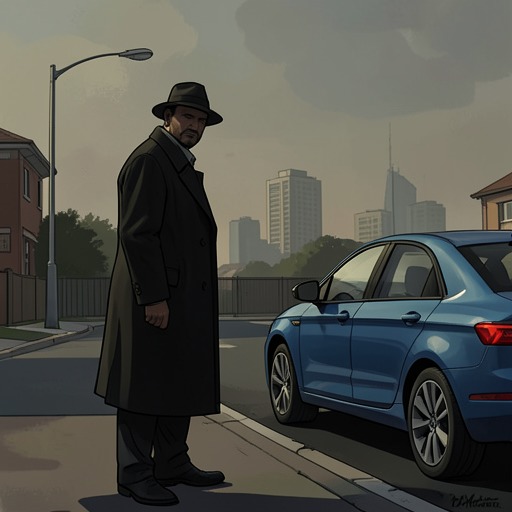
Leif Krognæss
The SonLeif Krognæss is a fifty-three-year-old man from Konnerud in Drammen whose brief encounter on an old road becomes crucial evidence in the investigation of Kjersti Morsand’s murder. He has no established connection to Sonny Lofthus before that meeting; what makes him important is that he remembers Sonny well enough to confirm that Sonny was elsewhere when the killing took place. The episode turns an incidental act of attention into an alibi, and an alibi into a challenge to the case against Sonny.
Identity and Introduction
Detective Inspector Henrik Westad identifies Leif by name and age after tracing the details Sonny gave in a later interview. Leif lives in Konnerud, in Drammen, and recognizes Sonny from a photograph shown to him by police. He is not introduced as a suspect or associate, but as an ordinary motorist whose recollection unexpectedly bears on a murder investigation.
Leif’s identification is the result of a specific investigative lead. Sonny had described an alibi witness called Leif, who drove a blue Volvo with an “I ♥ Drammen” sticker; Sonny also associated him with a heart problem. Westad checks Volvo dealers in Drammen and the Cardiology Unit at Buskerud Central Hospital, using those unusual details to find the man. The search turns Sonny’s otherwise unverifiable claim into a traceable person and a testable account.
The Lay-by Encounter
On the relevant day, Leif had gone for a drive in the sunshine. Feeling strangely exhausted, he pulled over at a lay-by on the old main road running parallel to Drammensveien and remained there for several hours. The place was an infrequently used roadside stop with picnic tables; motorists generally preferred the newer road, and the nearby pond had midges. Leif’s unplanned pause placed him in a position to observe two men who were sitting at another table.
The two men sat without speaking for hours, apparently waiting. Eventually one glanced at his watch and said it was time to leave. As they passed Leif’s table, the other man stopped to ask his name and told him to see a doctor because something was wrong with his heart. His companion pulled him away, and Leif assumed that the man who had spoken might be a psychiatric patient on an outing. They then drove off. The encounter was brief, but the specific warning gave Leif a reason to remember the stranger.
A Warning That Becomes Evidence
Leif could not shake off the exchange, so he went to his doctor. Examination confirmed that he had a heart problem, and he was admitted to hospital immediately. The warning therefore proved consequential in Leif’s own life: the man he had met had recognized a danger that Leif himself did not yet know about. When Leif later recognized Sonny from the police photograph, he described the stranger as the person who had saved his life.
That personal significance also explains the strength of Leif’s recollection without turning him into a witness to the murder itself. He can identify Sonny and place him at the lay-by; he does not report seeing Kjersti’s death. Westad connects the meeting to the medical examiner’s timing: Kjersti was killed at the very time the men were at the lay-by. Leif’s account thus supports Sonny’s alibi for the critical period.
Role in the Case Against Sonny
Sonny had first been interviewed by Westad and later changed his statement, retracting his confession and claiming an alibi. Westad had waited to issue a press release because something about Sonny’s attitude did not add up. The revised account initially offered a witness identified only as Leif; Westad’s checks and Leif’s recognition supply the independent confirmation that the claim needs. The sequence makes Leif part of a larger correction: Sonny’s confession cannot simply be treated as proof when the timing and a verifiable witness contradict it.
The investigators also consider a strand of hair connected to the crime scene, but Westad says that Sonny has an alibi. Leif’s testimony does not itself explain every piece of evidence or resolve every question surrounding the case. Its specific force is temporal and personal: it places Sonny at the lay-by when the medical examiner says Kjersti was killed, and it is corroborated by a witness whose memory was fixed by the unexpected warning and subsequent hospital admission.
Narrative Significance
Leif’s part in the plot rests on a chain of contingencies rather than a planned intervention. Sonny notices a stranger’s heart problem; Leif takes the warning seriously enough to seek medical care; and that encounter later enables him to recognize Sonny in a photograph. The same brief meeting is therefore both a life-saving act for Leif and a decisive piece of evidence for Sonny. Its consequence is not that Leif solves the murder, but that his ordinary, verifiable experience undermines a seemingly settled accusation and makes the truth of Sonny’s whereabouts harder to dismiss.